
There is a striking statistic that early childhood researchers reach for again and again, because it reframes everything about what happens in a childcare room. In the earliest years of life, a child’s brain builds connections at a speed it will never match again.
According to the Center on the Developing Child at Harvard University, the brain forms 1 million new neural connections every second in the first few years. Those connections are shaped, for better or worse, by the experiences a child has during the day.
Once that lands, it changes how you look at the place your child spends three days a week. It is not minding. It is construction.
Why “Just Playing” Is the Serious Part
For a long time, play and learning were treated as opposites, with play framed as the fun bit you allow before the real instruction starts. The research has thoroughly demolished that split.
Play is how young children build executive function — the focus, working memory and self-regulation that underpin everything they will later do in a classroom. Through play, children practise problem-solving, negotiation, language and persistence, all while it looks, to an adult, like they are simply messing about with blocks.
Studies comparing approaches have found that guided, play-based learning can outperform direct instruction for early learners, particularly in areas like mathematical and spatial reasoning. The key word is guided. This is not children left to their own devices; it is educators using play with intent, steering it toward specific skills without crushing the joy that makes it work.
That distinction is the difference between a room full of toys and a genuine program. The toys are easy. The intentional, scaffolded use of them is the hard, skilled part.
What This Looks Like on the Ground
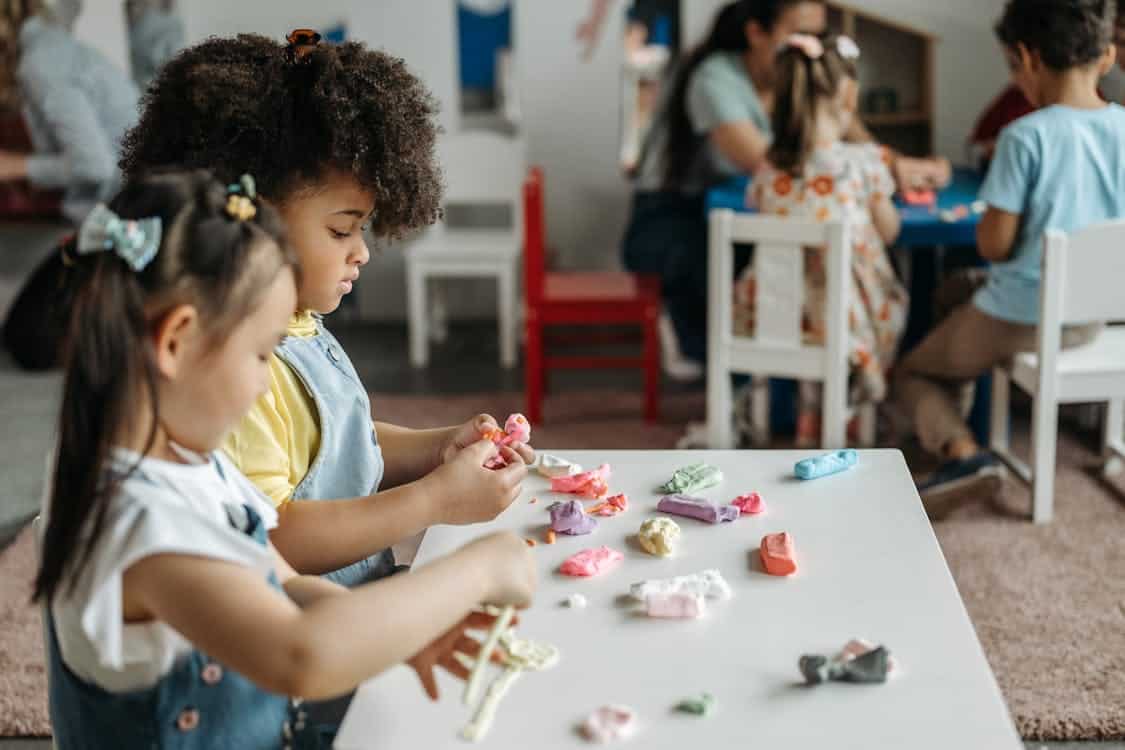
The practical version of all this is surprisingly tangible. A dedicated space for messy art, a corner set up for early science and tinkering, a quiet garden, real responsibility like helping care for animals — these are not decoration. Each one is a different invitation for a child’s brain to do something useful.
Varied environments matter because different kinds of play build different circuits. A child negotiating a shared project is exercising social and language skills; the same child working out how water moves through a creek bed is doing something closer to early physics.
This is why the better centres talk about curriculum-based early learning rather than just supervision. A curriculum, in this context, is not worksheets for four-year-olds. It is a deliberate framework that makes sure the play a child does across a week actually adds up to something.
It is also why the environment is worth scrutinising on a tour. Purpose-built rooms and outdoor spaces signal a service that has thought about how children learn, rather than one that has simply filled a floor with furniture.
The Questions That Cut Through the Brochure
Every centre will tell you it does play-based learning. The phrase has become close to mandatory marketing. The job for a parent is to work out who means it.
Ask an educator to walk you through how a single activity connects to a developmental goal. The ones running a real program can do it instantly and specifically. The ones using the language as a slogan will get vague.
Ask how they document what your child is working on, and how they decide what to offer next. Intentional teaching leaves a trail, because educators are tracking where each child is and nudging them forward.
The brain science sets a high bar, and it is worth holding centres to it. The first five years are a one-time window, the experiences during them are doing real structural work, and the place a child spends those days is helping decide what gets built.